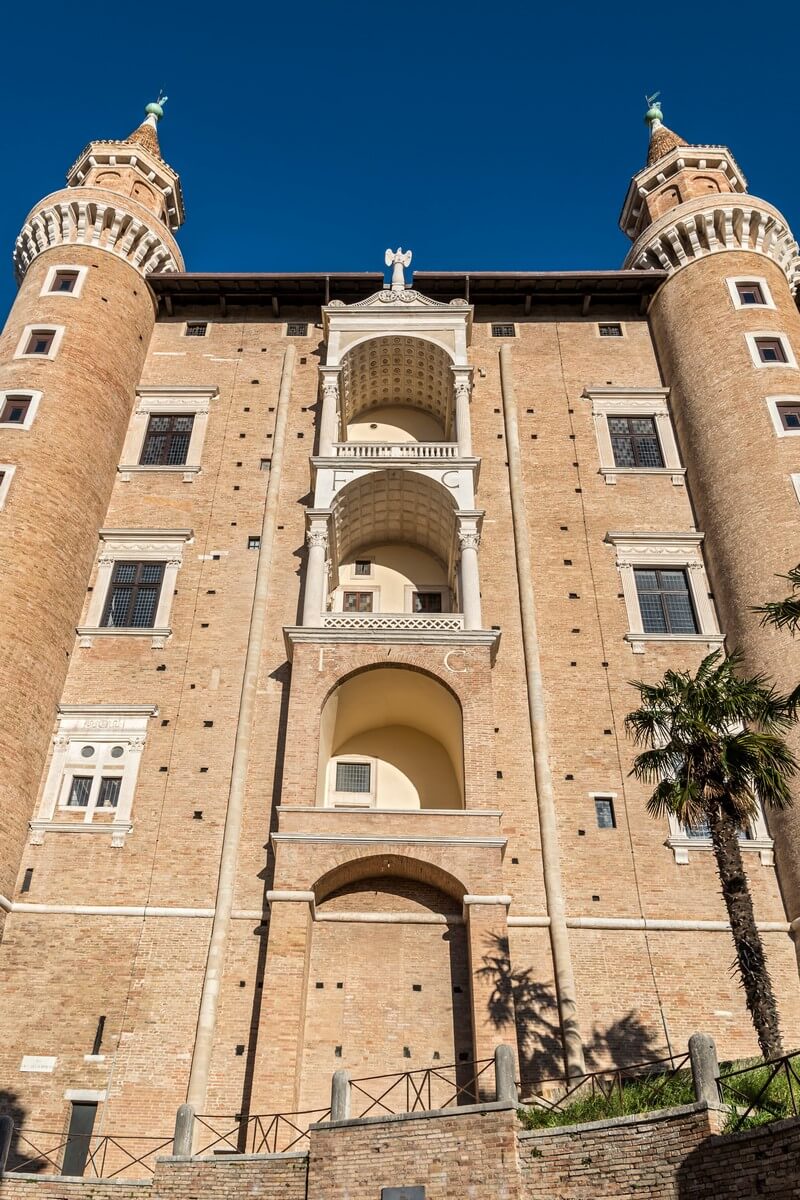

All in Urbino is art and magic. Everything here recalls the perfection of the ideal city: every stone on the roads, every staircase and every portico ooze with poetry. To visitors of the hills in the Metauro Valley, the city appears like a sudden vision. Its Ducal Palace (a divine rather than human building, painter Giovanni Santi, Raphael’s father, called it) stands out at the horizon, and Nature embraces it. The old heart of the city, a lively cosmopolite centre, is intact. One pleasantly walks, holding onto the wrought-iron banisters that stick out of the walls to avoid sliding on the steep staircases (fit for the clogs of horses, which passed here at the time of the Duke, more than for human feet), enjoys the sun that peeps out through the roofs leaning against each other, and looking at the surrounding hills is charmed by the only place in Marche UNESCO proclaimed a World Heritage Site: a wonder of art and harmony that radiates the spirit of Urbino and of its citizens: the spirit of Renaissance. A mathematical and geometric beauty joins the polyhedral elegance perceivable beyond the thresholds of the Ducal Palace, the city in the shape of a palace, the stage of the fascinating court of Guidobaldo da Montefeltro and Elisabetta Gonzaga which Castiglione celebrated in his most famous Cortegiano; the ideal city where perspective, harmony and balance of the first Renaissance join in the perfection of a place, a fortress that was transformed into an open, shared space, designed according to the rational and exact architectural rules so well shown in the painting The Ideal City. Urbino is Federico da Montefeltro, it is an expression of the Duke, of his enlightened government inspired by the principles of confidence.


Urbino