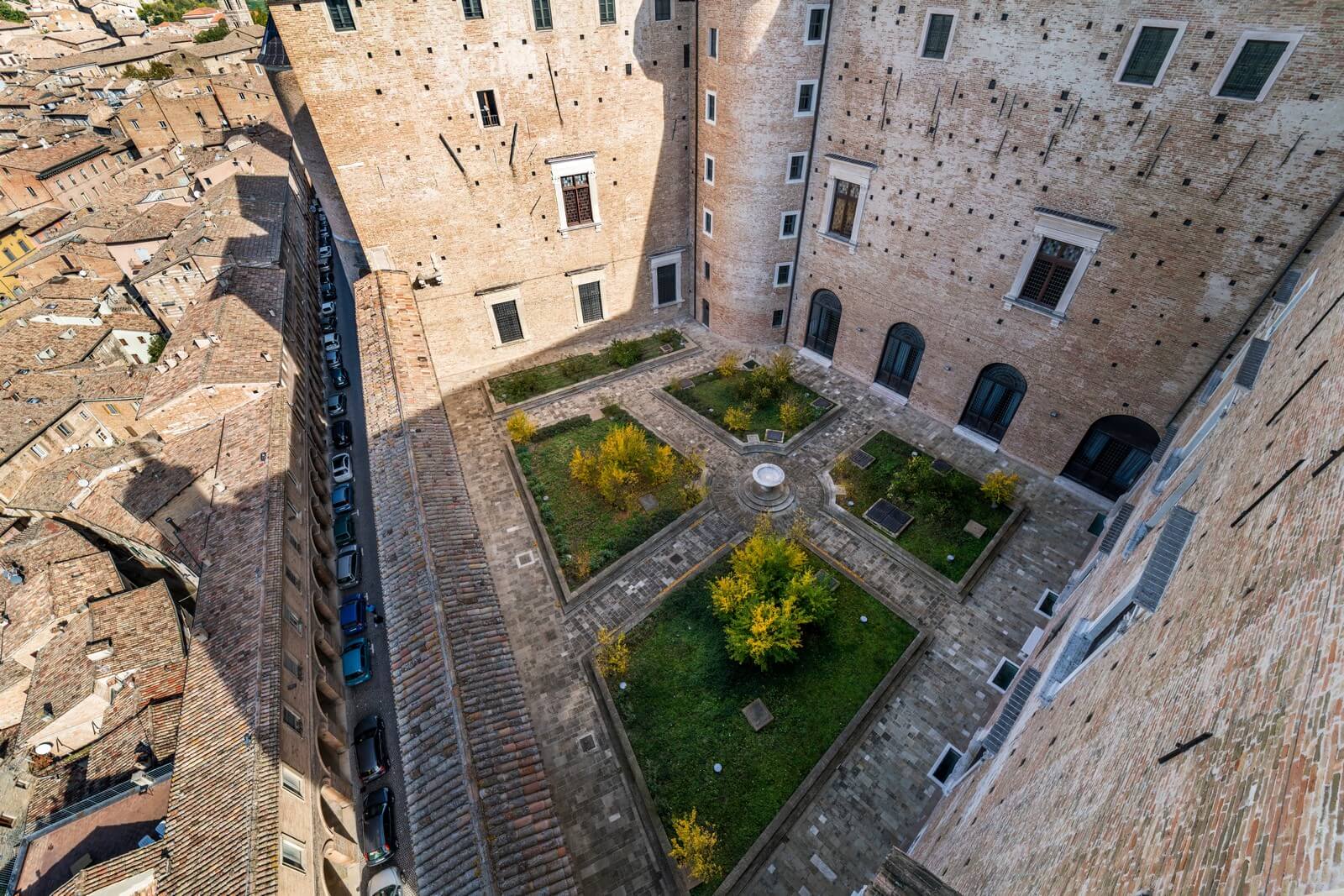

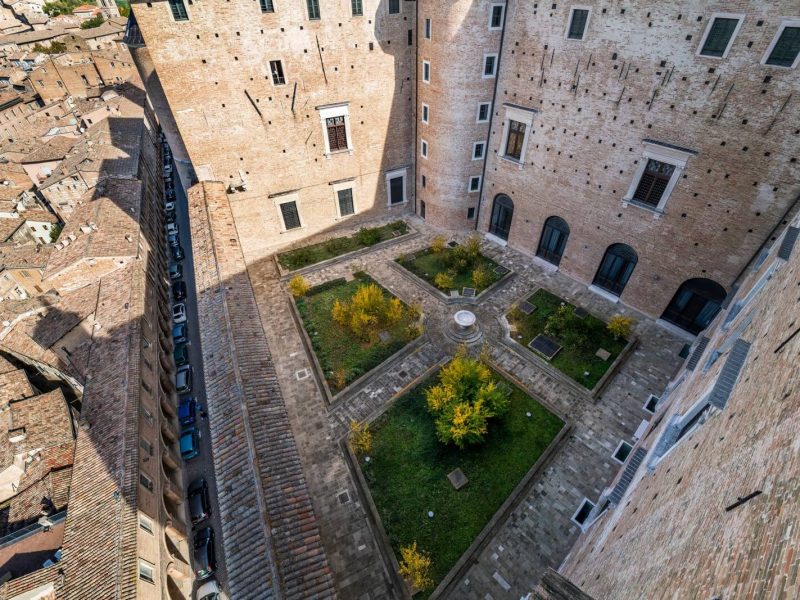
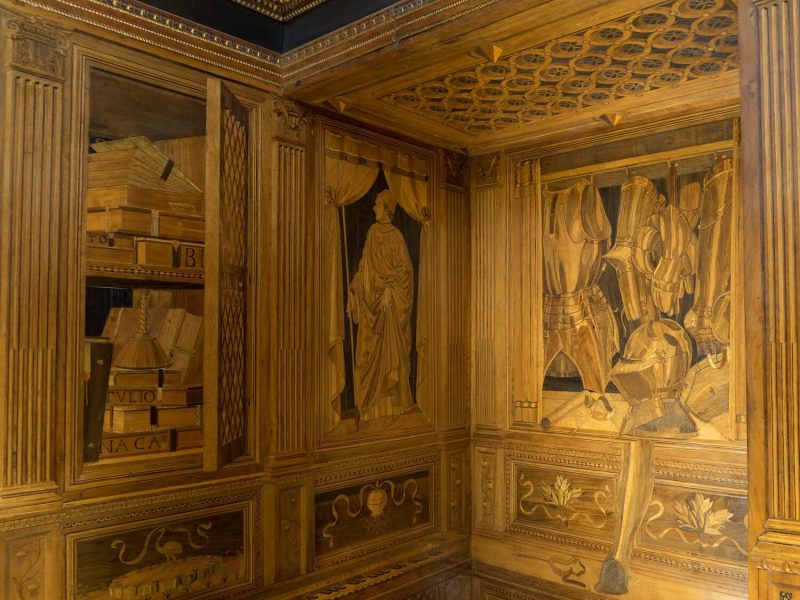
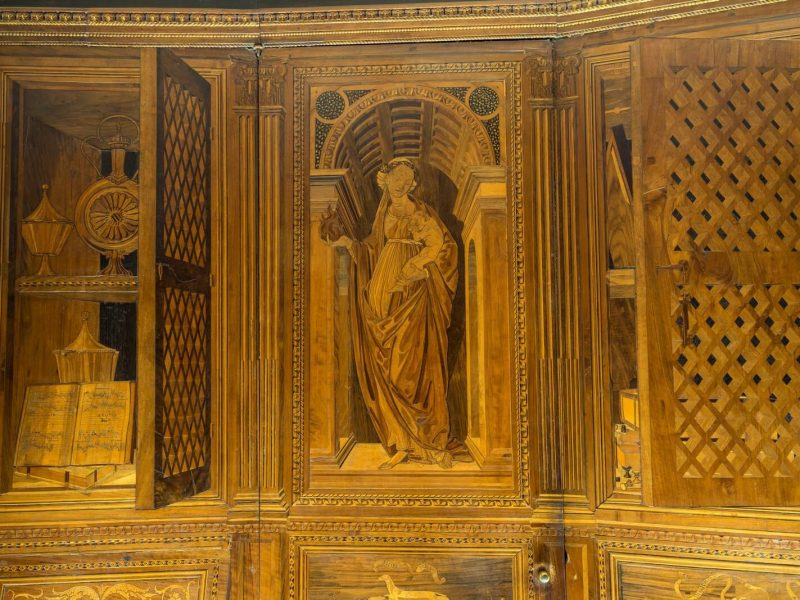
In the centre of the beautiful hanging garden of the Ducal Palace, there is a rare sample of a concave-bottom sundial, a fruit of the mathematical knowledge of the Urbino Renaissance scholars, which perfectly integrates with the five above-ground large flowerbeds hosting rare plants. The same care for details can be found anywhere else in the Palace: for instance in the caves, where the activities necessary to make the Court work took place, equipped with original hydraulic devices, stables, kitchens, and even Federico’s private bathroom, right beneath the most private area of the building that hosted the little chapel of Forgiveness and of the Aedicule of Muses, and Federico’s studio. The latter is the most famous place in the whole Palace, an incomparably beautiful chest: beauty fills the richly inlaid wooden walls, the harmony of perspectively painted objects and the portraits of learned men who inspired the mind, the actions and the spirit of the Duke. Here he cultivated his culture, his thirst for knowledge: into this intimate and private little office he read law, geography, mathematic essays and works by Greek and Latin classics.
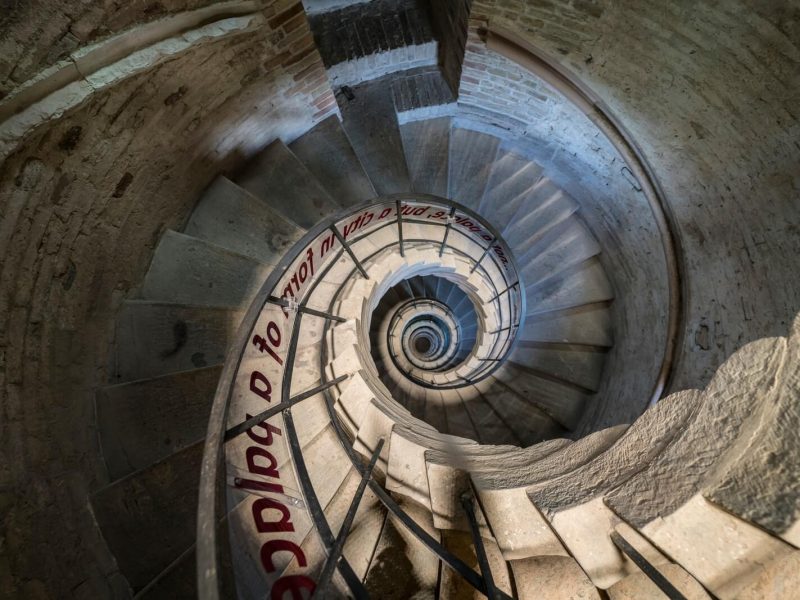
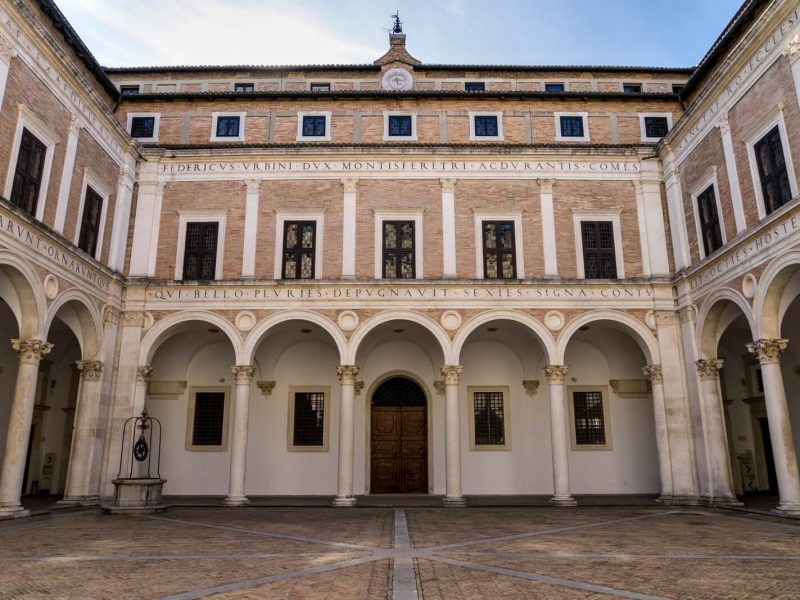
The unique design of the Ducal Palace resumes in its geometric, rational and perspective structure the ideals of Renaissance. The way it develops in all directions conforming to the surrounding landscape, The Torricini (little towers) façade, emblem of the city, the court of honour with its arches and columns, the colours, changing from brick red to the whitest sandstone (“travertine from Mount Nero”), make the Ducal Palace, created by Luciano Laurana and Francesco Di Giorgio Martini, a pearl inside the city. The fairy-tale North Tower of the Palace is open to visitors, who may go up its spiral staircase, get to the top balcony and admire the wonderful surrounding landscape, the same appearing in the works of the greatest painters of that time. The Ducal Palace hosts nowadays the National Art Gallery of Marche, a real mine of precious masterpieces by such artists as Piero della Francesca, Paolo Uccello, Pedro Berruguete, Giusto di Gand, Luca Signorelli, Titian, Federico Barocci and most of all Raphael Sanzio, whose splendid Portrait of a Young Woman (La Muta) is exposed in the Duchess’ apartment.

Urbino