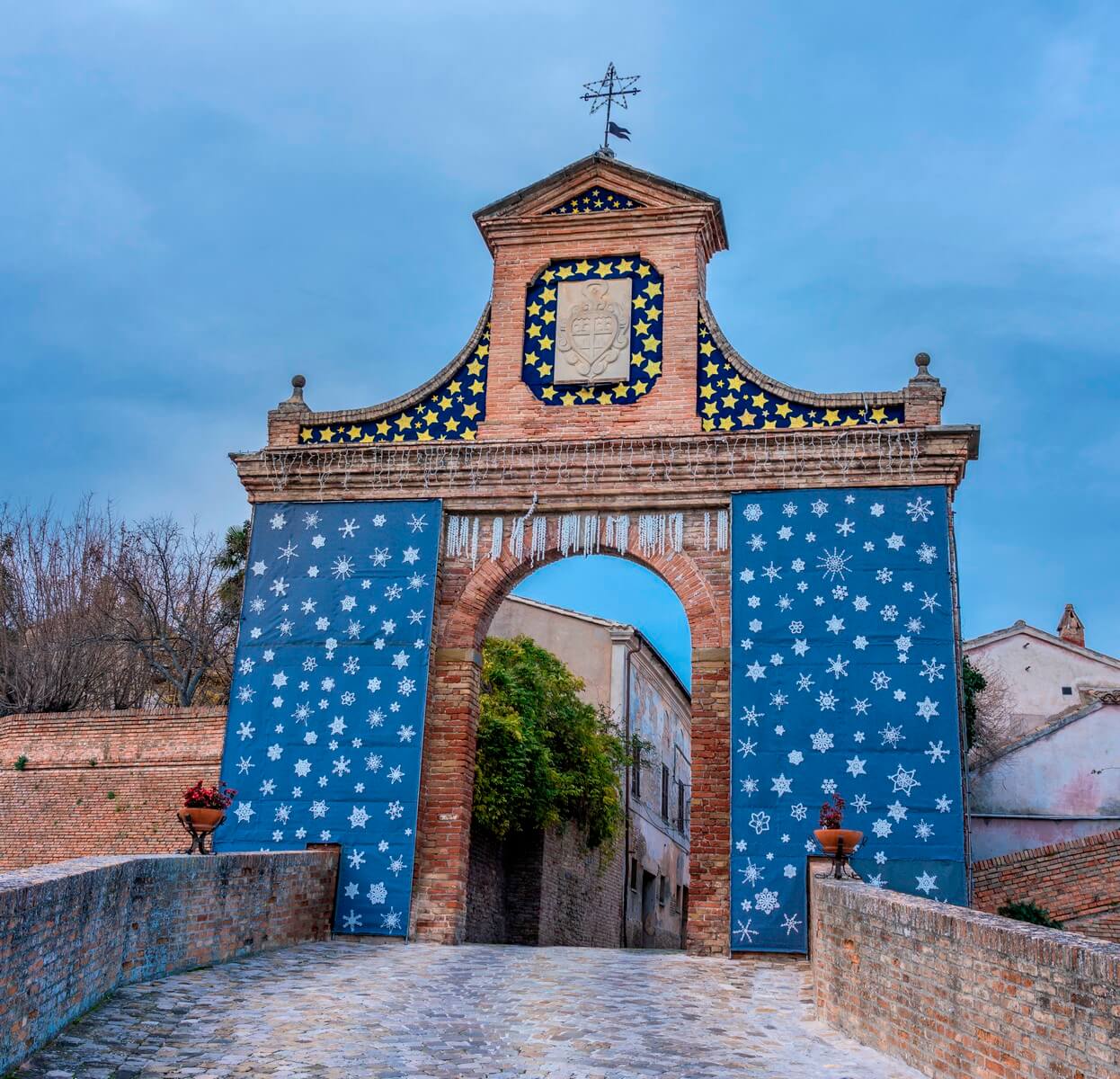

It is there, along the road, almost unexpected, that suddenly appears the architectural jewel represented by Barchi. An uphill cobblestone road leads to Porta Nova (“New Door”), a monumental and luxurious entry, announcing the charms waiting inside the ancient city walls. The design of the town is signed by Filippo Terzi, a great architect who since 1571, charged by the Barchi marquis Pietro Bonarelli, worked on the project of a little “Ideal City” of Renaissance. Barchi was one of the best works of Terzi’s, who gave the town a structure as much functional as fascinating, by redesigning it completely as if it was a work of art and enriching it with monuments, sumptuous buildings and proficient solutions of military defence. So here is the elegant Corso (the main road) across the whole town; the Square in the centre, thought so as to look like an imaginary stage to those who come in from Porta Vecchia (the Old Door); Palazzo Comunale (City Council) and its tower topped by a pinnacle, dominating the whole valley and built based on an anthropomorphic mould, with extraordinary optical effects, based on the “divine proportion”. Overlooking the main square there is another important work of Terzi’s: the Collegiata di Sant’Ubaldo (St. Ubaldo’s Collegiate). The church, built with three naves, the central one more elevated than the others, hosts in the side altars such remarkable paintings as the Crucifixion with saints Ubaldo and Francis, attributed to Nicolò Martinelli, the anonymous St. Michael Archangel and The Virgin, St. Mary Magdalene and St. Francis, possibly a work by young Guerrieri. In the walkway above the main entrance there is an important historical organ, beautiful and unusual because of its pastel colours, built by Venetian Gaetano Callido, the main exponent of the neoclassic organ building school in the XVIII century. A little, apparently anonymous road, may lead, in Barchi, to places as rich with history and legend as the Dogal Palace which is told to have hosted for years Lavinia della Rovere, supposed to be the Young Woman (“La Muta”) painted by Raphael , and the starting point of one of the many caves that create a labyrinth beneath the town. There is not a corner or a perspective, anywhere here, which does not offer a moment of wonder.

Barchi